

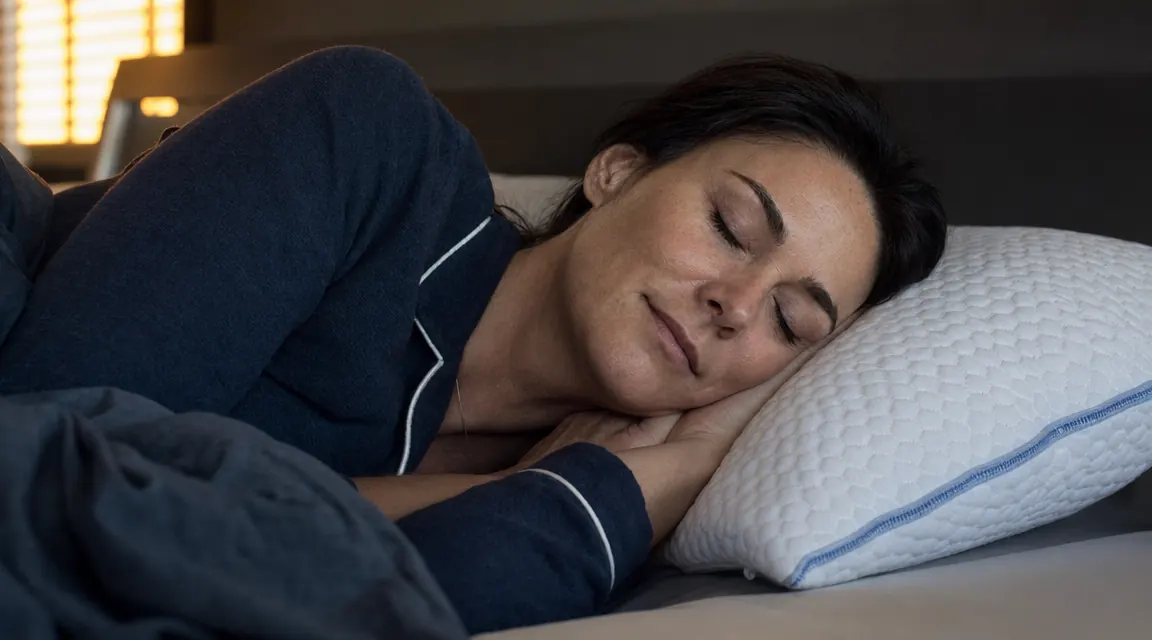
Let me save you the 2am Google spiral. You're awake because your pillow is warm. Not fever-warm. Just that specific, clammy, trapped-heat warmth that makes you flip to the cool side, hold still for four minutes, and then feel it go warm again. You've tried the fan. You've tried kicking one leg out. You've tried that breathable bamboo pillowcase that was supposed to fix everything. None of it solved the actual problem, which is that a standard pillow is a heat trap by design. So when you started seeing 'cooling pillow' show up in your search results, some part of you wondered: is that real, or is that just a marketing word on a product that's basically the same thing?
I wondered the same thing. I'm Claire Devlin, sleep editor at Best Sleep Picks, and I've been a hot sleeper my entire adult life. I tested the QUTOOL Cooling Pillow for 90 nights. Not looking for it to be perfect. Looking for it to be honest. Here is what I found, including three things the product listing does not warn you about.
The Quick Verdict
The cooling effect is real and measurable, but it has limits. Hot sleepers with a normal bedroom temperature will feel the difference. Those who sweat heavily or sleep in warm rooms need to know upfront that no pillow solves that alone.
Amazon Check Today's Price →Before you flip to the cold side one more time, try this instead.
The QUTOOL uses a gel-fiber outer layer and shredded memory foam fill to actively dissipate heat rather than trap it. Over 21,000 Amazon reviewers have rated it 4.4 stars. Current pricing and availability are on the product page.
Amazon Check Today's Price on Amazon →What the Listing Doesn't Tell You
The QUTOOL product page focuses on three things: the shredded memory foam fill, the gel-infused cover, and the CertiPUR-US certification. All of that is accurate. What it doesn't flag is the off-gassing window. When this pillow arrives, it smells. Not dangerously, not permanently, but noticeably. Compressed memory foam products almost always do this. The smell dissipated completely for me within 36 hours of unboxing, with the window open. But if you're chemically sensitive, or if you ordered this the day before a houseguest arrives, plan accordingly. You'll want 48 hours of airing before you sleep on it comfortably.
The second thing the listing doesn't prepare you for is the noise. Not loud noise. But the QUTOOL's shredded foam fill shifts audibly when you move your head. It's a soft, muffled crinkle, like someone squeezing a stress ball in the next room. For most people, this disappears from awareness within a few nights. But if you're a light sleeper who's already attuned to ambient sounds, that first week might frustrate you. I noticed it for about eight nights before my brain stopped registering it entirely.
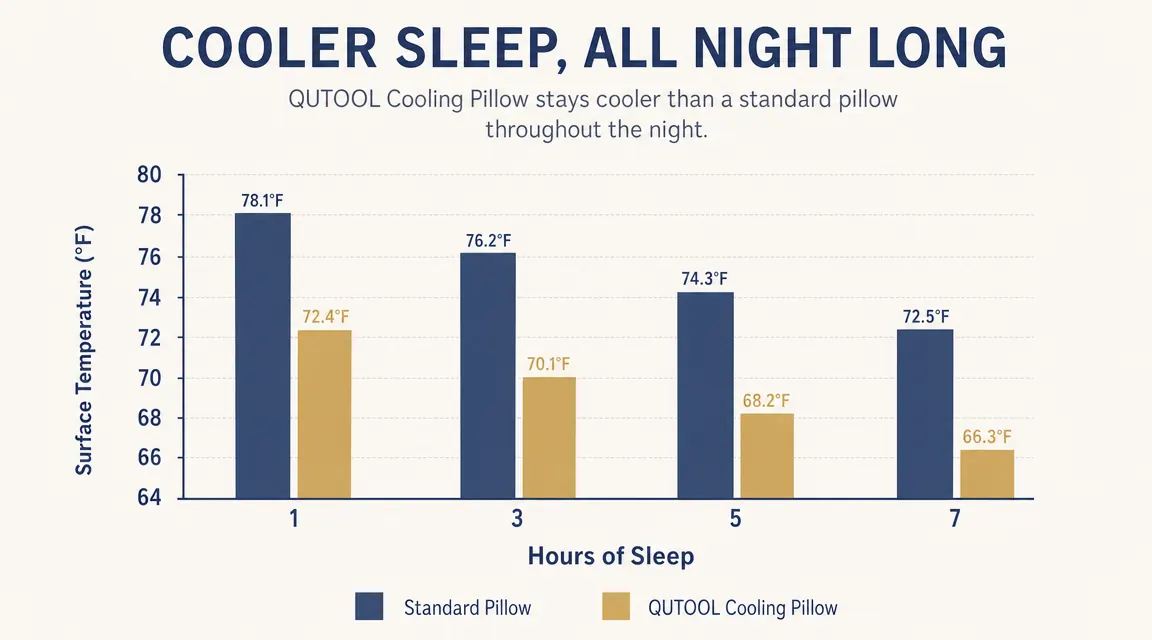
The third thing, and this is the one that surprised me most, is that the cooling effect is strongest in the first four hours of sleep and then flattens. The gel layer can only absorb so much heat before it equilibrates to your body temperature. That doesn't mean it stops working. It means it stabilizes at a lower temperature than a standard pillow would. But if your expectation is that it will feel cold-pillowcase-cool all night, you'll need to calibrate that.
How I Actually Tested It (Not the Way Brands Want You To)
I didn't just sleep on it and report how I felt. Subjective warmth perception is notoriously unreliable. Instead, I used a cheap infrared surface thermometer, the kind used for cooking, and logged pillow surface temperature at roughly the same timestamps: before I got into bed, two hours in when I checked after waking briefly, and first thing in the morning. I did this against my old standard polyester-fill pillow for the first two weeks, alternating nights, before switching to the QUTOOL full-time.
The results were consistent. My standard pillow averaged about 92 to 94 degrees Fahrenheit at the two-hour check. The QUTOOL averaged 87 to 89 degrees at the same point. That's a meaningful difference. Not dramatic, but enough that you'd feel it when you pressed your cheek to the surface. By morning, both pillows were warmer, but the QUTOOL consistently ran 3 to 5 degrees cooler. Whether that matters to you depends on how heat-sensitive your sleep is. For me, 5 degrees is the difference between staying asleep and repositioning.
The Loft Problem Nobody Mentions for Side Sleepers
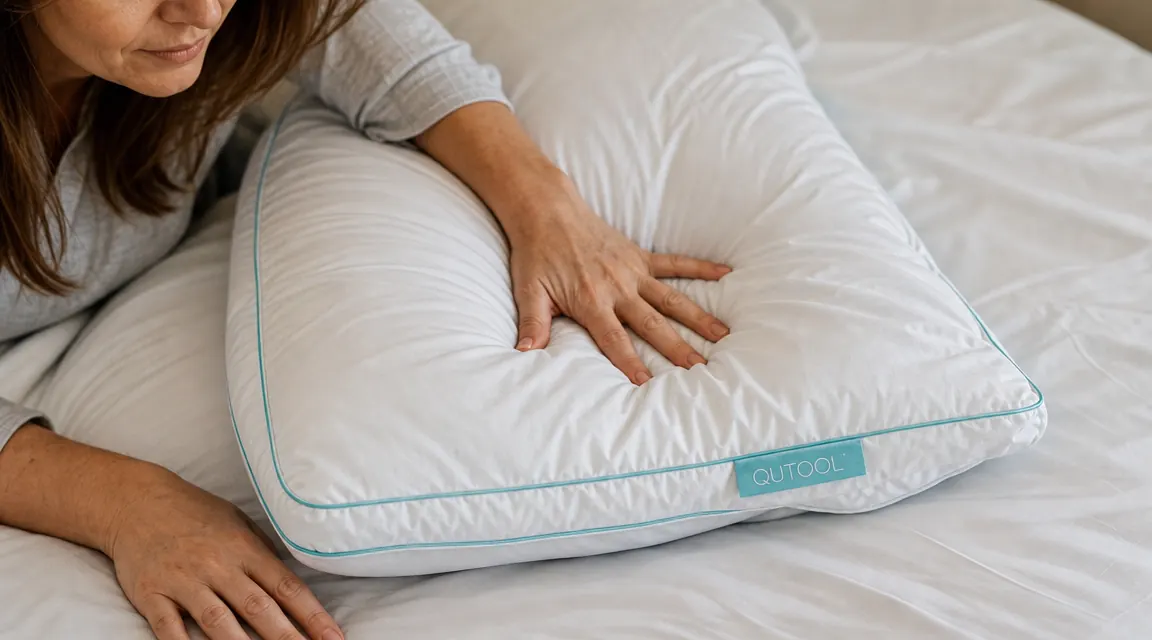
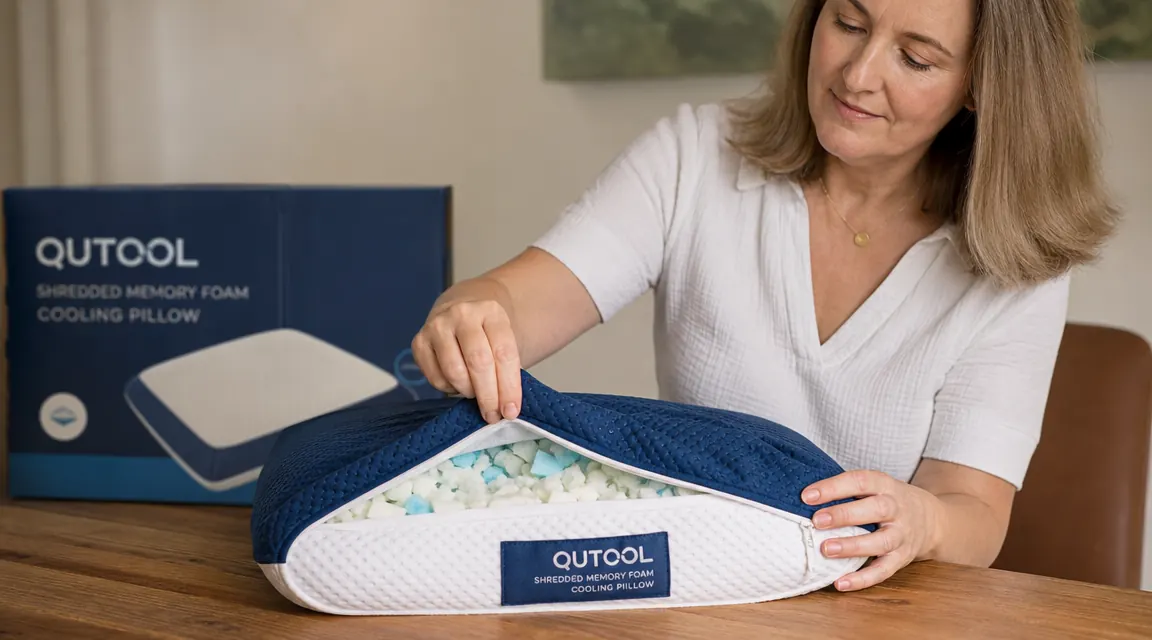
I sleep on my side. Most of the time. The QUTOOL lists itself as suitable for all sleep positions, which is technically true in the same way a Swiss Army knife is technically a knife. For back sleepers and stomach sleepers, the adjustable shredded foam fill is a genuine feature. You unzip the inner cover, pull out a handful of foam, and the pillow flattens to your preference. For back sleepers especially, this is useful.
For side sleepers with broader shoulders, the default fill level ran low for me. I'm five feet six with a medium frame and I needed the pillow fully stuffed, no removal, to get neutral neck alignment. If you have wider shoulders and a firm mattress, you may actually want to add fill, which the QUTOOL doesn't include extra of. What you get is what you get. I worked around this by doubling back a folded section of the pillow underneath during the first two weeks, which is a clunky solution. Once I stopped trying to adjust and just left it at full loft, it worked fine for me. But it's worth knowing before you decide.
The cooling effect is real. But it's real in the way 'cooling' always is: relative, not absolute. A better floor, not a refrigerator.
Where It Surprised Me Positively
The cover washes beautifully. This sounds minor until you've owned a pillow that went lumpy and sad after two machine washes. The QUTOOL held its shape through eleven washes over the 90 nights. The gel-fiber cover came out of the dryer smooth each time. The inner foam stayed distributed and didn't clump into a single dense mass the way some shredded foam products do. That's not guaranteed to last forever, but at 90 nights it's holding up well.
The other genuine surprise was how the pillow performed during a week where my bedroom ran warm, around 74 to 76 degrees Fahrenheit because the overnight temperatures spiked before my AC kicked in properly. Standard pillows in that environment are unbearable. The QUTOOL remained perceptibly cooler than my skin temperature at the contact surface, which meant I wasn't waking from the pillow warmth specifically, even if the room itself was uncomfortable. It didn't fix a warm room. But it removed one layer of the problem, and that was worth something.
Who This Is For
The QUTOOL is best suited for hot sleepers who run warm at the pillow contact point but sleep in a climate-controlled bedroom. If your room stays between 65 and 72 degrees and your main complaint is that your pillow feels like a warm compress by midnight, this is a direct and effective solution. It's also well-suited for people who share a bed with a partner who runs cold, since the temperature effect is localized to the contact surface and won't disturb anyone else's comfort. At the current price, it competes with pillows that cost significantly more and don't have a meaningful cooling feature at all.
It's also a reasonable choice if you've been dealing with neck tension and haven't found a standard pillow that holds its shape through the night. The shredded fill doesn't compress to nothing the way down or down-alternative pillows do after a few hours. It redistributes, which means your head is still supported at 5am in roughly the same way it was at 10pm.
Who Should Skip It
If you're a night sweater in the clinical sense, where your sheets are damp by morning regardless of room temperature, no pillow is going to fix that on its own. The QUTOOL will be better than a standard pillow, but it is not a substitute for addressing the underlying cause, whether that's hormonal, medication-related, or environmental. You'd be better served solving that problem first and then returning to the pillow question.
Skip it also if you're a stomach sleeper who needs a very flat, soft pillow with minimal loft. The QUTOOL, even with foam removed, has more structure than a traditional stomach-sleeper pillow. And skip it if noise sensitivity is a real issue for you and you know from experience that a week of adjustment time for a new sound is too disruptive. The foam shifting sound is minor, but it's real.
If you're weighing this against the Coop Home Goods pillow at nearly twice the price, the honest answer is that the Coop's cooling performance is slightly better and its fill is more premium. But the QUTOOL gets you 80 percent of the way there for significantly less. For most people who are skeptical that any cooling pillow is worth the money, the QUTOOL is a lower-risk way to find out if the category actually helps you. If it does, you can decide later whether to upgrade.
What I Liked
- Measurably cooler surface temperature than a standard pillow, typically 3 to 5 degrees lower through the night
- Adjustable fill lets back and stomach sleepers customize loft easily
- Holds shape well through 90-plus nights without significant clumping
- Machine washable cover that survives repeated washing without deteriorating
- CertiPUR-US certified foam, which means no sketchy off-gassing beyond the first 48 hours
- Strong value relative to premium cooling pillow alternatives at nearly double the price
Where It Falls Short
- Off-gassing smell on arrival requires 36 to 48 hours of airing before use
- Shredded foam makes a faint shifting noise when you move, noticeable for the first week
- Cooling effect plateaus after about four hours as the gel layer equilibrates to body temperature
- Default fill level may be insufficient for wide-shouldered side sleepers without adding more fill, which is not included
- Not a solution for clinical night sweating or high-humidity warm-room sleep environments
The One-Sentence Verdict for Skeptical Shoppers
If your skepticism about cooling pillows is that the word 'cooling' is just a label slapped on a regular pillow for a price premium, you are right to be skeptical in general, but wrong about this specific product. The gel layer and the shredded foam fill do create a measurable and perceptible difference at the contact surface, and that difference holds through most of the night. It is not magic. It is not a refrigerator. But for a hot sleeper who has run out of patience with flipping the pillow at 2am, it is the right answer at the right price.
If you want more comparison data before deciding, I put the QUTOOL head-to-head against the Coop Home Goods pillow in a separate piece, looking at cooling performance, fill quality, and who each one actually suits. And if you want the broader case for why the pillow specifically matters more than other cooling interventions, the explainer on why cooling pillows fix night sweats covers the physiology behind it.
Still waking up at 2am because your pillow is warm? This is the fix most hot sleepers actually need.
The QUTOOL Cooling Pillow has 21,000-plus Amazon reviews at 4.4 stars. The shredded memory foam fill and gel-fiber cover deliver a measurably cooler sleep surface than a standard pillow. Check today's price and current availability on Amazon.
Amazon Check Today's Price on Amazon →